
Does Bali Mean ‘Return’? Debunking the Myth: The Cultural Story Behind ‘Island of Sacrifice’
‘Bali means return—everyone who visits Bali will come back again!’
Many travelers have heard this saying.
Whenever someone asks about the origin of Bali’s name, there’s always someone who says that in Indonesian, ‘Bali’ means ‘return,’ so anyone who visits will miss the island and feel compelled to return.
It’s a romantic notion that fits Bali’s enchanting reputation.
But here’s the question: Does Bali really mean ‘return’ in Indonesian?
In reality, this is a common linguistic and geographical misconception. Looking at linguistics, ancient inscriptions, and Bali’s cultural background, there’s another compelling explanation: the name may derive from ancient Sanskrit, meaning ‘offering, sacrifice, or devotion.’
This article takes you through the history and culture behind the name Bali.
1. Does “Bali” Mean “Return”?
First, let’s start with the language.
In Indonesian (Bahasa Indonesia), common words for “return” or “come back” include:
- Kembali: to return, come back.
- Balik: to go back, return, also meaning to flip or turn over.
So why do some people say Bali means “return”?
The reason likely ties to Javanese (Bahasa Jawa).
In Javanese, bali does indeed mean to go home or return. The Indonesian Ministry of Education’s Javanese-Indonesian Dictionary also lists this word, defining it as pulang (to go home).
Thus, Bali is not entirely unrelated to the concept of “return” linguistically, but we must distinguish:
- Javanese bali: to go home, return.
- Indonesian ‘kembali’: to return, to come back.
- Bali: a place name with a long history.
These three cannot be directly equated.
In other words, while Javanese has a word ‘bali’ meaning ‘to return,’ it doesn’t mean the name of this Indonesian island evolved from the concept of ‘coming back.’
This is also why this explanation is easily misconstrued online.
2. Another Interpretation of Bali: Derived from Ancient Sanskrit, Meaning Offering and Devotion

Aside from the ‘return’ theory, there’s another noteworthy etymological explanation for Bali: its roots in ancient Sanskrit.
In Sanskrit:
Bali (बलि)
carries meanings such as offering, sacrifice, ritual tribute, and devotion.
And another Sanskrit term:
Dwipa (द्वीप)
means island.
Thus, Bali Dwipa (Bali Dvipa) has a common etymological interpretation:
Island of Offerings
This explanation is not merely a tourist marketing story. A 2023 academic study exploring the place names of Bali proposed that Bali Dwipa may derive from the Sanskrit bali-dvīpa, meaning ‘Island of Offerings.’
However, it should be noted that the exact etymology of Bali still has other scholarly interpretations, so ‘Island of Offerings’ should be regarded as a well-supported etymological hypothesis rather than a definitively settled translation.
3. Why Does ‘Island of Offerings’ Fit Balinese Culture So Perfectly?
If you’ve ever been to Bali, you’re likely familiar with the religious offerings found everywhere.
Whether at hotel entrances, restaurants, shops, homes, or even on streets and in front of temples, you’ll often see small woven bamboo leaf baskets filled with flowers, rice grains, food, and incense.
This is a very important part of daily life in Bali—the culture of religious offerings.
Canang Sari: Offerings You See Every Day
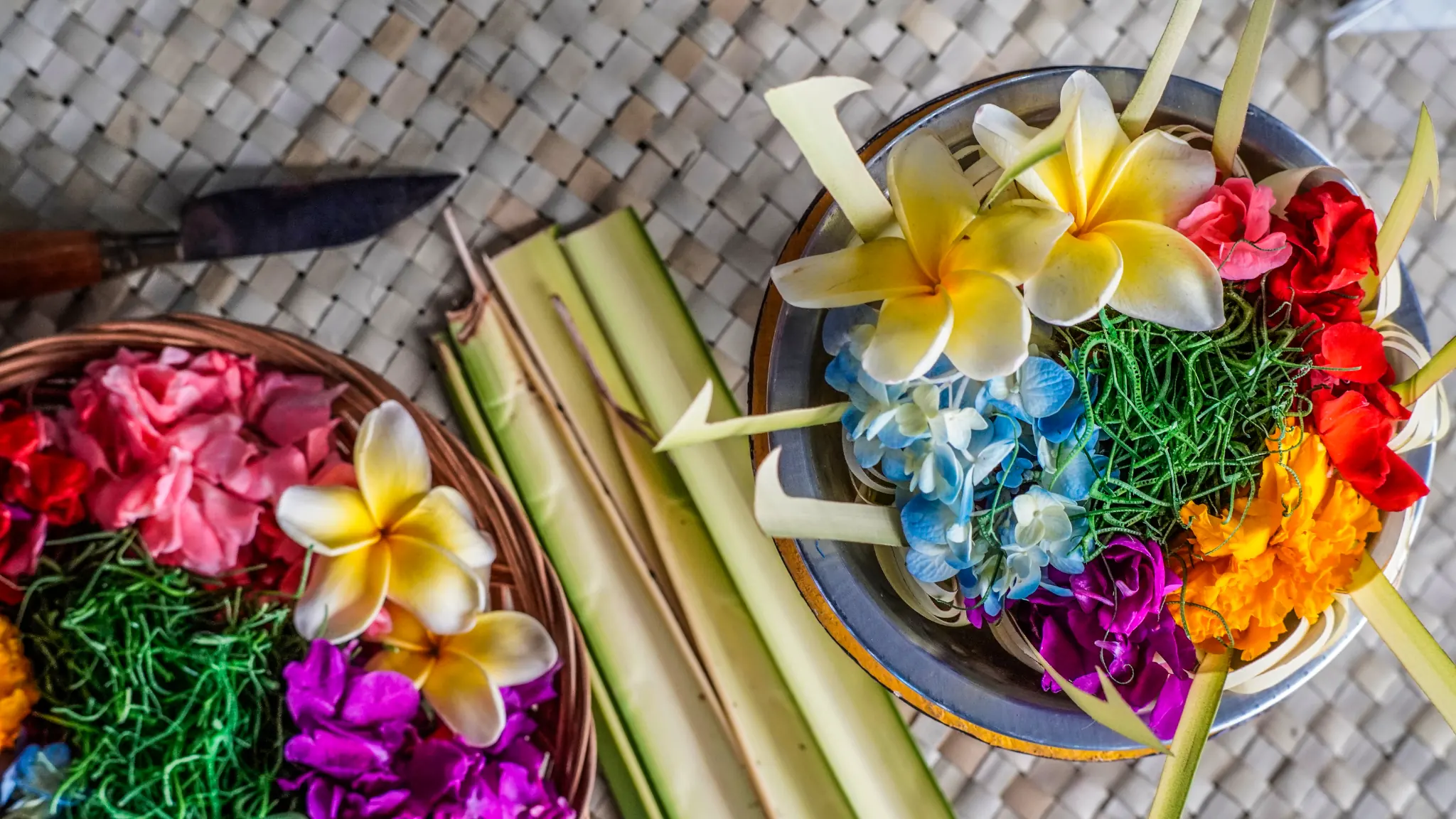
Canang Sari are small daily offerings made by Balinese Hindus.
They are typically crafted from woven coconut or palm leaves into small baskets, filled with colorful flowers, grains of rice, and other offerings, sometimes accompanied by incense.
These offerings are often placed at home entrances, shops, temples, and other locations as a gesture of gratitude and respect to the gods.
For locals, this is not just a religious ritual but an integral part of everyday life.
Banten: Offerings in Various Religious Ceremonies
Banten is a general term for the various offerings used in Balinese Hindu rituals.
Depending on the specific ceremony, occasion, and purpose, the materials, shapes, and methods of making the offerings vary.
Some offerings are quite intricate, made with fresh flowers, fruits, rice, coconut leaves, and other materials, showcasing Bali’s unique religious art and culture.
Yadnya: The Spirit of Offering and Sacrifice
Yadnya is a key concept of offering and sacrifice in Bali’s Hindu culture.
It represents not just the act of giving items, but also a spirit of gratitude and devotion to gods, ancestors, nature, and life.
From daily small offerings to grand temple ceremonies, this cultural importance is evident throughout Balinese life.
Therefore, when we see that Bali may be linked to the Sanskrit word Bali (meaning offering, tribute, or sacrifice), it’s easy to understand why the interpretation of ‘Island of Offerings’ resonates so deeply with Bali’s cultural identity.
4. How Old Is the Name Bali? Uncovering Answers from Sanur’s Millennia-Old Inscription
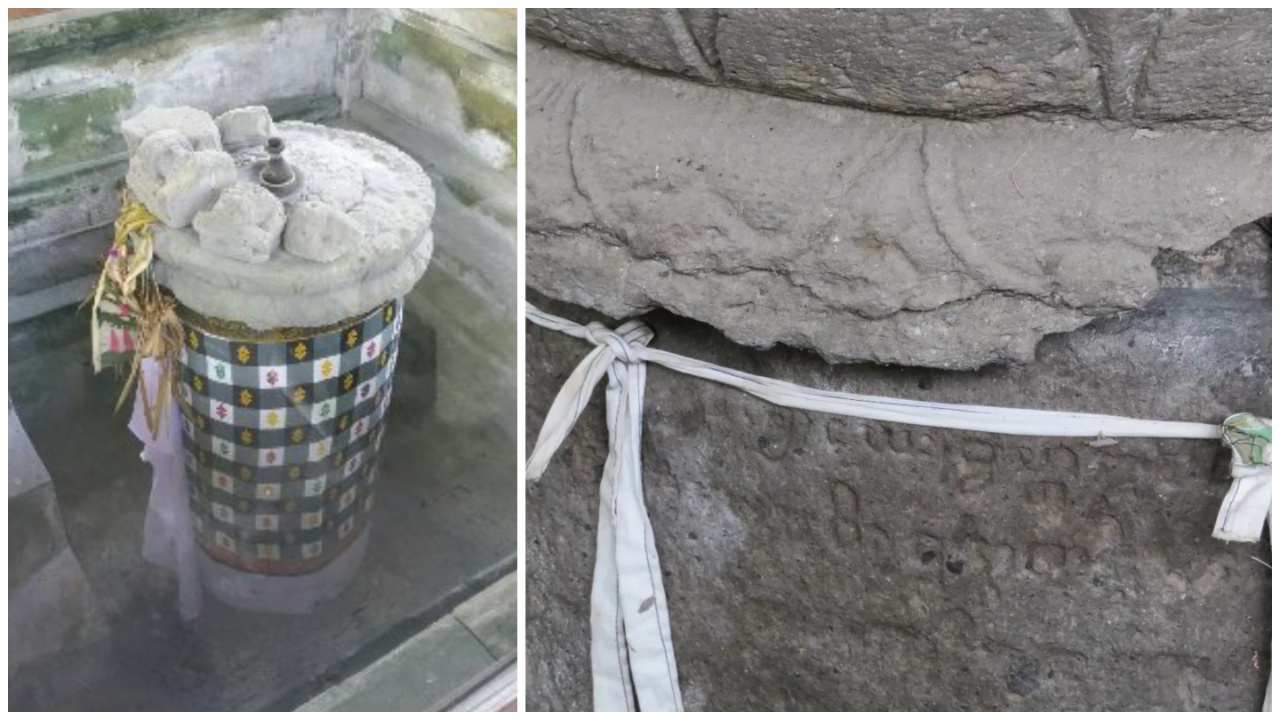
To explore the history of Bali’s name, one must mention the Blanjong Inscription located in Sanur.
This ancient stone pillar, known as Prasasti Blanjong (Blanjong Inscription), is a crucial historical artifact of Bali.
The inscription is associated with King Sri Kesari Warmadewa, who ruled Bali, and dates to Saka 835, typically converted to around 913 AD.
The inscription includes the name Walidwipa, which is generally believed to refer to present-day Bali.
Among them:
- Wali/Bali: part of the place name.
- Dwipa: Sanskrit for island.
The significance of this stone lies in the fact that it provides physical evidence of Bali’s early place names and history.
It is worth noting that the Walidwipa in the inscription does not directly prove that Bali derives from the Sanskrit word for ‘offering’ or ‘sacrifice,’ but it does show that the name of Bali has a very long history and is not a modern tourist name.
If you have the chance to visit Sanur, consider heading to the Blanjong area to see this ancient stone that bears witness to Bali’s thousand-year history.
Sanur Travel Guide Map: 50+ Food, Fun, Icon Bali Mall, Top Spas, and High-Value Accommodation Tips

5. Is Bali Really the ‘Island of Offerings’ or Something Else?
In fact, there is no fully consistent academic consensus on the exact etymology of Bali.
Beyond the Sanskrit interpretation of bali-dvīpa (Island of Offerings), another theory suggests that Bali may be related to the Sanskrit word Vali (वली).
This interpretation understands Bali Dwipa as a name connected to waves—essentially, the ‘Island of Waves.’
Therefore, the current rigorous summary is as follows:
| Term | Explanation | Assessment |
|---|---|---|
| Javanese “bali” | To return, to go back | Exists, but cannot be directly used as the origin of the island’s name |
| Sanskrit “bali” | Offering, tribute, devotion | An etymological hypothesis supported by dictionaries and toponymic research |
| Sanskrit “vali” | Wave-related interpretation | Another etymological hypothesis |
| Bali Dwipa | The island of Bali, name of the island | Found in ancient inscriptions and historical records |
VI. Conclusion: Bali May Not Mean ‘Return,’ But It’s Certainly a Place You’ll Want to Come Back To
Next time you hear someone say:
‘Bali means return—everyone who goes there comes back!’
You can tell them that this is actually a confusion between the Javanese word bali and the name of the island.
The name Bali has a long history, and one interpretation supported by academic research traces it to the Sanskrit Bali, meaning offering, tribute, or sacrifice. Hence, Bali Dwipa is also understood as the ‘Island of Offerings.’
The name Bali has a long history. One explanation supported by academic research is that it originates from the Sanskrit word ‘Bali,’ meaning offerings, sacrifices, and devotion. Thus, Bali Dwipa is also interpreted as the ‘Island of Offerings.’
This explanation also brings to mind the daily religious offering culture seen everywhere in Bali.
Of course, there are still different views on the historical etymology, but one thing is quite interesting:
Bali may not necessarily mean ‘return,’ yet it is a place that makes many people, after leaving, still miss it and want to come back.
This sentence might be the most romantic explanation for Bali.
References
- Spatio-historical Data Enrichment for Toponomastics in Bali, The Island of Gods (2023), explores the possibility that Bali Dwipa originates from the Sanskrit bali-dvīpa, meaning ‘Island of Offerings,’ along with other etymological hypotheses.
- Cultural Tourism in Bali, Cornell University digital collection, discusses the Sanskrit bali and its etymological connection to offerings.
- Indonesian Ministry of Education’s Kamus Bahasa Jawa-Indonesia, for the Javanese meaning of bali.
- Blanjong: An Ancient Port Site in Southern Bali, Indonesia, studies the Blanjong inscription and the history of Walidwipa.
- ISEAS, research on the Blanjong ancient site and inscriptions.


No discussions yet — be the first to ask.