
update: 2026/05/26
Bottom line: Bali uses 220V voltage and European two-round-pin sockets (Type C/F). Taiwanese appliances need an adapter (available at local supermarkets for about NT$30–40, roughly USD$1). Make sure your phone, camera, and laptop chargers support 220V (most 3C devices do, but high-wattage items like hair dryers and curling irons require extra attention to voltage range).
Indonesia and Bali operate on a standard voltage of 220 volts (220V)—crucial info for travelers bringing electronics. Before packing, ensure your devices support international 220V standards to use them properly in Indonesia and Bali.
Beyond voltage, socket type matters too. Indonesia uses European-style two-round-pin sockets. Without the right adapter, many hotel outlets may be unusable.

Source: YouTube Xiao Jie Indonesia
Do You Need an Adapter?
You can buy adapters at local supermarkets; they’re called “Adaptor” (pronounced ah-dap-tor in Indonesian). You can also ask your hotel if they provide adapters, but not all do—so it’s best to grab one at a local store to be safe. They’re cheap, around NT$30–40 (about USD$1).

Typically, you’ll need at least one adapter plus a 220V-compatible multi-outlet extension cord to power all your devices in Indonesia and Bali. When choosing an extension cord, don’t skimp on quality—opt for a reputable brand to safely use all your electronics.
How to Prepare a USB Charger?
Modern USB chargers that travelers bring abroad (like phone and tablet charging heads) typically support a wide voltage range of 100V-240V. As long as the input voltage range marked on the charger includes 220V, you can use it directly in Bali without an extra transformer. Before you go, check the small print on your charger—if it says “Input: 100-240V,” it’s good to go; if it only says 110V, you’ll need to replace it.

If you’re planning to bring a multi-outlet extension cord like the one pictured above, first make sure it supports the 110~220V range. Second, check the plug type—those bought in Taiwan usually have two flat prongs, so you’ll also need an adapter (as mentioned at the top) to use it safely in different hotels or villas. Finally, if your devices support PD or QC fast charging, it’s best to choose a corresponding high-power charger to significantly cut charging time and reduce travel anxiety!
Can This “Square-Prong” Universal Adapter Be Used in Bali?

Recently, a traveler in a group asked: “Can this universal adapter be used in Bali? I’ve heard online that you need a fully round plug?” The responses from many netizens sharing their real experiences boiled down to a very consistent point:
✔ It works, but often “not very stable”
Most travelers said:
- It can plug in
- Most hotels can charge normally
- But the plug tends to loosen and wobble.
- If it’s too heavy, it can even fall off.
The reason is that Indonesia (including Bali) commonly uses European Type C / Type F sockets, many of which feature a ‘recessed circular’ design. If your universal adapter:
- Has prongs that are too short,
- Has a square body behind the prongs,
- Is too large and heavy,
it may not seat fully, resulting in poor contact.
Many seasoned travelers just buy one locally 😆
In this discussion, many netizens mentioned:
‘They sell them at convenience stores and supermarkets in Indonesia, and they’re very cheap.’
Small, ultra-light, yet even more stable.
🔌 Different Socket Types Across ASEAN Countries
Socket and plug standards vary across Southeast Asia, so checking your destination’s type before departure can save you a lot of hassle finding adapters locally. For example, Singapore commonly uses Type G sockets with three rectangular prongs, which are not directly compatible with the Type C and F plugs found in Bali. The Philippines, on the other hand, uses both Type A and Type B sockets: Type A has two flat pins, while Type B adds a grounding pin—both require attention to ensure compatibility with your devices.
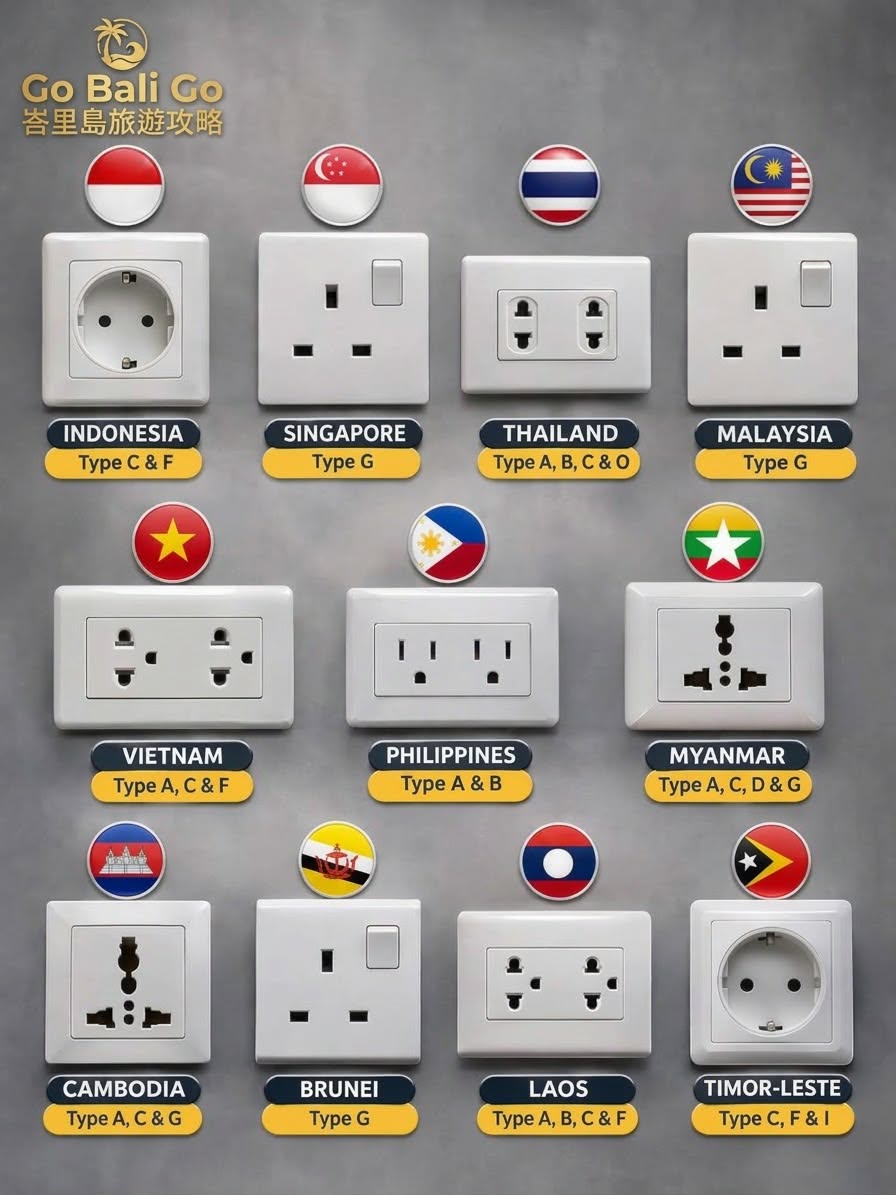
If your trip includes both Bali and other ASEAN countries, it’s a good idea to list all the adapters you’ll need in your packing checklist and prepare them in advance for a smoother journey.
Where to Buy 220V Multi-Outlet Extension Cords?
If you’re looking for a 220V multi-outlet extension cord, they might be hard to find in physical stores, but there are plenty of options available online. Many e-commerce platforms and online electronics specialty stores offer a wide range of 220V multi-outlet extension cords, including those with USB ports, making it easy to find one that suits your needs.
Can I Bring My Own Hair Dryer or Curling Iron?
Most hotels provide hair dryers for guests, but some do not.
It’s recommended to check with your hotel in advance to see if they offer a hair dryer. If not, or if you need a specific model or brand, you’ll need to consider the solutions mentioned earlier, such as buying a local 220V hair dryer or using a voltage converter.
If you bring your own hair dryer from Taiwan, note that most are designed for 110V only. In Indonesia and Bali, where the standard voltage is 220V, a 110V hair dryer won’t work properly and may even be damaged due to voltage mismatch.
For this situation, the safest and most convenient solution is to buy a hair dryer that supports 220V locally. This way, you can ensure it works properly in Indonesia and Bali, while avoiding damage caused by voltage mismatch.

Other Areas/Villa Accommodation Recommendations
- Renaissance Bali Uluwatu Resort: Family-Friendly Highlights
- Alila Villas Uluwatu|World's Top 10 Infinity Pools ✧ Celebrity Wedding Destination
- 【Budget Villas in Seminyak】Affordable Bali Villas Under $100
- 【Family Villa】Recommended 3-Bedroom, 4-Bedroom, 5-Bedroom, and 6+ Bedroom Private Villas for Groups
- 【Canggu Villa Stay Guide】10+ Bohemian Pool Villas to Recommend
- 【Ubud Villa Stay Guide】20+ Private Pool Villas in a Secluded Paradise
- 【Bamboo Villa】Explore 10+ Treehouse/Bamboo Villas Nestled in Nature in Ubud
- 【Seminyak Villa Stay Guide】20+ Stunning Secret Garden Villas in Bali
If you really need to use your own hair dryer or curling iron, you can also consider using a voltage converter or adapter. A converter can step down 220V to 110V, but make sure to use one that provides sufficient wattage (W) and meets safety standards to avoid damaging your devices or posing a safety risk.
For travelers heading to Indonesia and Bali, understanding these voltage and plug details is crucial. Avoid using cheap chargers of unknown origin—under 220V, low-quality products can overheat and pose safety risks. Prepare the right adapters and multi-outlet extension cords to keep your electronics running smoothly, so you can fully enjoy your vacation without worrying about compatibility issues.
What else should you buy at supermarkets in Indonesia/Bali?
Check out Xiao Jie’s introduction


No discussions yet — be the first to ask.